The Doom Scroll Spiral: How Your Phone Is Training Your Anxiety to Get Worse

Tomorrow is International Women's Day (March 8), and I've been thinking about how many women I know who are carrying anxiety quietly while still showing up for everyone else. If that's you, this is for you. I wrote more about that in quiet resilience of anxious women.
Also, before anything else: I'm not a therapist or a medical professional. I'm a Somali-American woman in Minneapolis with lived experience of generalized anxiety disorder, and I share what helped me plus what I've learned from therapy and research. Take what fits, leave what doesn't, and talk to your own clinician about your specific situation.
I used to call it "staying informed."
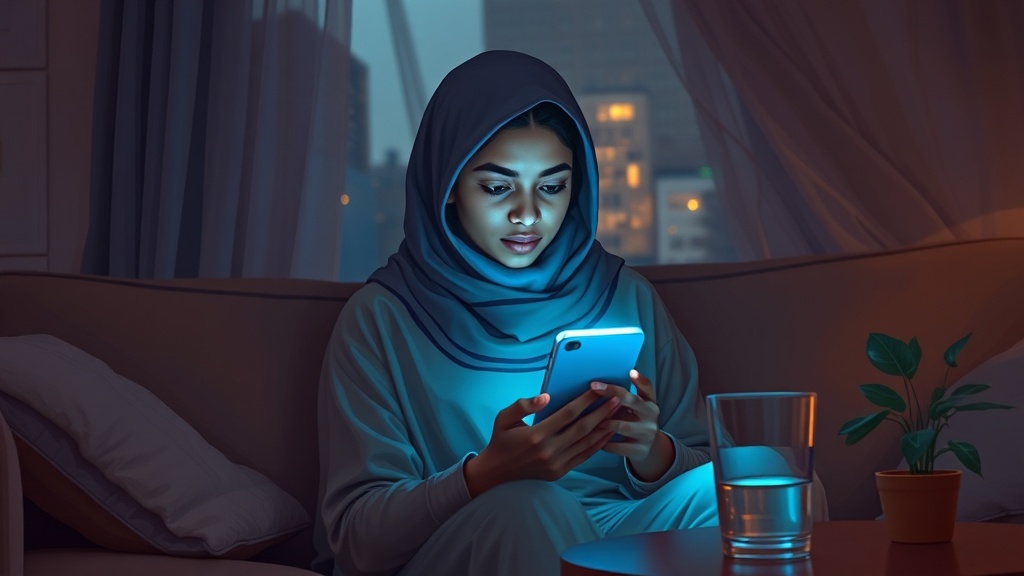
What it actually felt like was this: wake up, grab phone, open one app, then another, then another. Thirty minutes gone. Heart racing. Jaw tight. Body braced like something bad was about to happen in my apartment, not just on my screen. If you know that specific dread before you're even fully awake, my morning anxiety routine might help too.
That's doomscrolling anxiety in one sentence: your nervous system starts treating your phone like a threat detector.
And if you have an anxious brain, that design is not neutral.
Why infinite scroll hits anxious brains so hard
When people say "phones are bad," I tune out. That's too simplistic and honestly not useful.
What helped me was understanding the mechanism.
The infinite scroll is designed to remove stopping cues. There's no natural "end," so your brain never gets the tiny closure moment that says, "We're done now." People like Tristan Harris and the Center for Humane Technology have talked for years about these persuasive design patterns: variable rewards, endless feeds, and attention capture.
If you live with anxiety, that design can pour gasoline on existing patterns:
- Your amygdala is already quick to scan for threat.
- News-heavy and outrage-heavy posts trigger that alarm system.
- Stress hormones rise.
- You keep scrolling for relief, certainty, or control.
- You get occasional dopamine hits (a funny post, a reassuring take, a like, a "maybe things are okay" moment).
- Your brain learns: "When alarmed, scroll more."
That loop is brutal because it contains both fear and reward.
I remember sitting on my couch in Cedar-Riverside after work, telling myself I was too tired to do anything meaningful. I'd scroll "for five minutes." Then I'd look up 90 minutes later feeling more panicked, more behind on my life, and weirdly ashamed that I couldn't just close an app.
The shame part matters. Shame keeps the cycle private. Private cycles get stronger.
The doomscrolling anxiety feedback loop (in plain language)
Here's the loop I wish someone had named for me earlier:
- Step 1: You feel anxious or unsettled.
- Step 2: You reach for your phone to calm down, distract, or "check."
- Step 3: You absorb alarming content (bad news, conflict, comparison, urgency).
- Step 4: Your body gets a cortisol spike.
- Step 5: You keep scrolling to regulate the discomfort.
- Step 6: Anxiety rises, concentration drops, sleep gets worse, and sometimes it turns into the kind of 3AM anxiety spiral that makes everything feel catastrophic.
- Step 7: Next stress wave hits, and your brain remembers the phone as your automatic coping behavior.
That's why phone anxiety feels both compulsive and pointless. You're trying to self-soothe with the same thing that is dysregulating you.
In trauma-informed language, this can resemble a hypervigilance response. Dr. Bessel van der Kolk's work on nervous-system dysregulation helped me understand this: when your system feels unsafe, it seeks cues constantly. In 2026, many of those cues come through your screen.
So again: not a moral failure. A conditioned loop.
The real cost: what scrolling added vs. what it masked
I had to ask myself a hard question: "How much anxiety is the scroll creating, and how much is it helping me avoid?"
For me, doomscrolling did both.
What it added:
- Faster heart rate in the morning
- More catastrophic thinking
- Worse sleep latency (took longer to fall asleep)
- More irritability and less patience
- A constant sense of being emotionally "full"
What it masked:
- Fear of starting hard tasks
- Loneliness on days I didn't want to admit I felt alone
- Grief and anger I didn't have words for yet
- Avoidance of life admin that made me feel "behind"
When I started tracking this in my notes app for two weeks, it became obvious: scrolling was numbing me short-term and draining me long-term.
If that sounds familiar, you are not weak. You are using a very available coping behavior in a high-stress world.
What I actually changed (and what didn't work)
I tried dramatic fixes first. They failed.
Deleting every social app cold turkey lasted maybe 48 hours before I reinstalled "just one." Locking my phone in another room worked until I needed it for work messages. Turning everything off forever was not realistic for my life.
What worked was adding friction, not perfection.
1) I removed social apps from my home screen
Not deleted. Just moved.
That tiny extra step (searching for the app) gave me a two-second pause to ask: "Do I want this right now, or am I anxious right now?"
Those two seconds are a big deal in CBT terms. That's the gap where choice can come back online.
2) I used grayscale in the morning and evening
Color is stimulating. Grayscale made my phone less candy-like, especially during vulnerable windows: first hour after waking and last hour before bed.
Did I love it? No.
Did it reduce compulsive checking? Yes, noticeably.
3) I created specific scroll windows
This helped most.
Instead of random checking all day, I set two intentional windows (example: 12:30-12:50 PM and 7:00-7:30 PM). Outside those windows, I tried to keep social apps closed.
Important: I still broke this sometimes. But even "messy consistency" beat total autopilot.
4) I built a "break queue" for doom thoughts
This one came from therapy-style externalization plus trial-and-error.
Whenever I got the urge to "research" a fear by scrolling, I wrote the thought into a note titled Break Queue.
Examples:
- "What if the economy collapses and I lose housing?"
- "What if everyone else is handling life better than me?"
- "What if this symptom means something terrible?"
Then I gave myself rules:
- Write it down first.
- Wait 10 minutes.
- If it still feels urgent, pick one trusted source and read one article, not 30 posts.
Writing it down moved the thought from body panic to language. That alone lowered intensity.
5) I changed my feed inputs
I unfollowed high-alarm accounts that posted urgency 24/7 with no context.
I followed more grounding voices: practical mental health educators, local community pages, and creators who made me laugh without punching down.
I also muted keywords during high-stress weeks. Not forever. Just enough to keep my system from being flooded.
6) I replaced the first scroll with one body cue
For me: water + sunlight at the window + one long exhale before touching apps.
Not because this is magic. Because anxious brains need bottom-up signals of safety, not just top-down "be rational" lectures.
The neuroscience piece, without jargon overload
Research on screen use and anxiety is still evolving, and not every study says the same thing. But the trend in recent meta-analyses is consistent enough to take seriously: heavy/problematic social media use is associated with higher anxiety symptoms, especially when use is passive, compulsive, and comparison-driven.
That doesn't mean your phone "caused" your anxiety by itself.
It means phone habits can amplify an anxious baseline.
Think of it like this:
- Anxiety is the dry grass.
- Infinite scroll is wind.
- High-conflict content is sparks.
You don't need to blame yourself for the fire to decide you want better firebreaks.
A gentle reframe from CBT/EMDR that helped me
One of the most useful reframes I learned was externalization:
"I'm not broken. I'm interacting with a system built to capture my attention when I'm vulnerable."
That sentence shifted me from self-attack to problem-solving.
In EMDR and CBT work, we often separate identity from symptom. I'm not "an anxious failure." I'm a person with an anxious nervous system using learned coping behaviors. Behaviors can be updated.
That's hopeful, and it's practical.
If you want to try this, start here (7-day reset)
This is the exact low-pressure version I'd suggest a friend:
Day 1:
- Move social apps off home screen.
- Turn off non-essential push notifications.
Day 2:
- Set grayscale for morning + night.
Day 3:
- Pick two scrolling windows.
- Set a timer before opening apps.
Day 4:
- Create your
Break Queuenote. - Use it once before any doomsearch.
Day 5:
- Unfollow or mute five high-alarm accounts/keywords.
Day 6:
- Add one replacement ritual before first scroll.
Day 7:
- Review: What improved? Sleep? Focus? Panic intensity? Time reclaimed?
Then keep only what helped.
You're building a personal protocol, not passing a purity test.
When doomscrolling is a sign of something bigger
Sometimes doomscrolling anxiety is not the core issue. It's a visible symptom of deeper overload.
Please consider talking with a therapist or medical provider if:
- You feel unable to stop despite serious consequences
- Anxiety is interfering with work, school, relationships, or basic care
- You're having frequent panic symptoms
- You're using scrolling to avoid distress that feels unmanageable alone
- You're feeling hopeless, numb, or unsafe
If you're in immediate danger or thinking about harming yourself, call emergency services in your area right now. In the U.S., you can call or text 988 for the Suicide & Crisis Lifeline.
That is not failure. That is care.
For women carrying a lot right now
Since it's International Women's Day weekend, I want to say this clearly: many women are not just managing our own anxiety. We're carrying family logistics, community fear, financial pressure, caregiving, and the emotional weather of everyone around us. If weekends tend to make that dread louder, the Sunday scaries can be part of this picture too.
Of course the phone becomes an escape hatch.
Of course the scroll becomes a place to feel less alone.
You deserve support that goes deeper than "just log off."
For me, healing has looked less like dramatic detoxes and more like steady boundaries. Tiny acts of nervous-system respect repeated over time.
- Closing the app after one checked source.
- Putting the phone down before my body is fully fried.
- Choosing one real conversation over twenty anxious refreshes.
- Remembering I can be informed without being flooded.
I still slip. I still have hard weeks.
But now I can feel the spiral earlier, and I know what to do next.
If you needed permission today, here it is: your peace is more important than perfect awareness of everything, all the time.
And if your anxiety has gotten bigger than what self-help can hold, please bring this to a therapist, your doctor, or another qualified professional. You do not have to white-knuckle this alone.
I'm right there with you, still learning, still practicing, one boundary at a time.